Your HPC Summer School – Programmation and optimization on Heterogeneous Architectures (June 22 – July 3rd, 2026)
Presentation
The Gray Scott School is an advanced training program dedicated to High-Performance Computing (HPC), led by experts from IJCLab, CNRS, Inria, LUPM, LPNHE & LISN. This summer school, in a unique format and entirely free of charge, is dedicated to programming and optimization on Heterogeneous Architectures.
The school covers the optimisation of computations on different types of hardware (CPU, GPU), presenting their respective characteristics, architectures and bottlenecks. It covers generic optimisation methods applicable to all types of hardware, as well as the various libraries, technologies and languages available to achieve the best possible performance. Ideally, the peak performance of the machine.
Through hands-on sessions, lectures, and regular technical webinars, the school equips participants with the skills needed to design, optimize, and scale high-performance applications.
This GSS 2026 is over now! THANK YOU to everyone who attended and helped organize this event!
Please find below some information about this 2026 edition… and you can already register for next one below!
Format & Level ________________________________________________________________________________
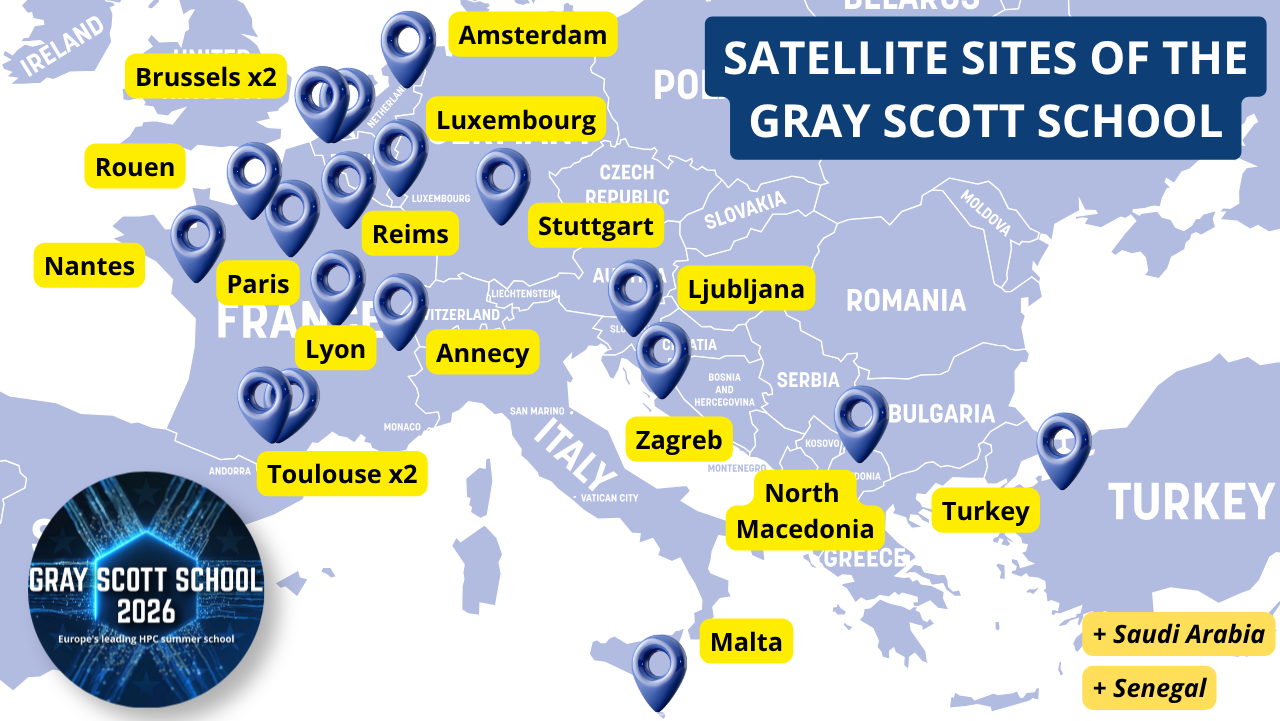
Online or onsite, in one of our Satellite Sites through all Europe:
Totally Free of charge.
Open to students, researchers, and professionals with basic programming experience who wish to develop HPC competencies
Satellite Sites Partners
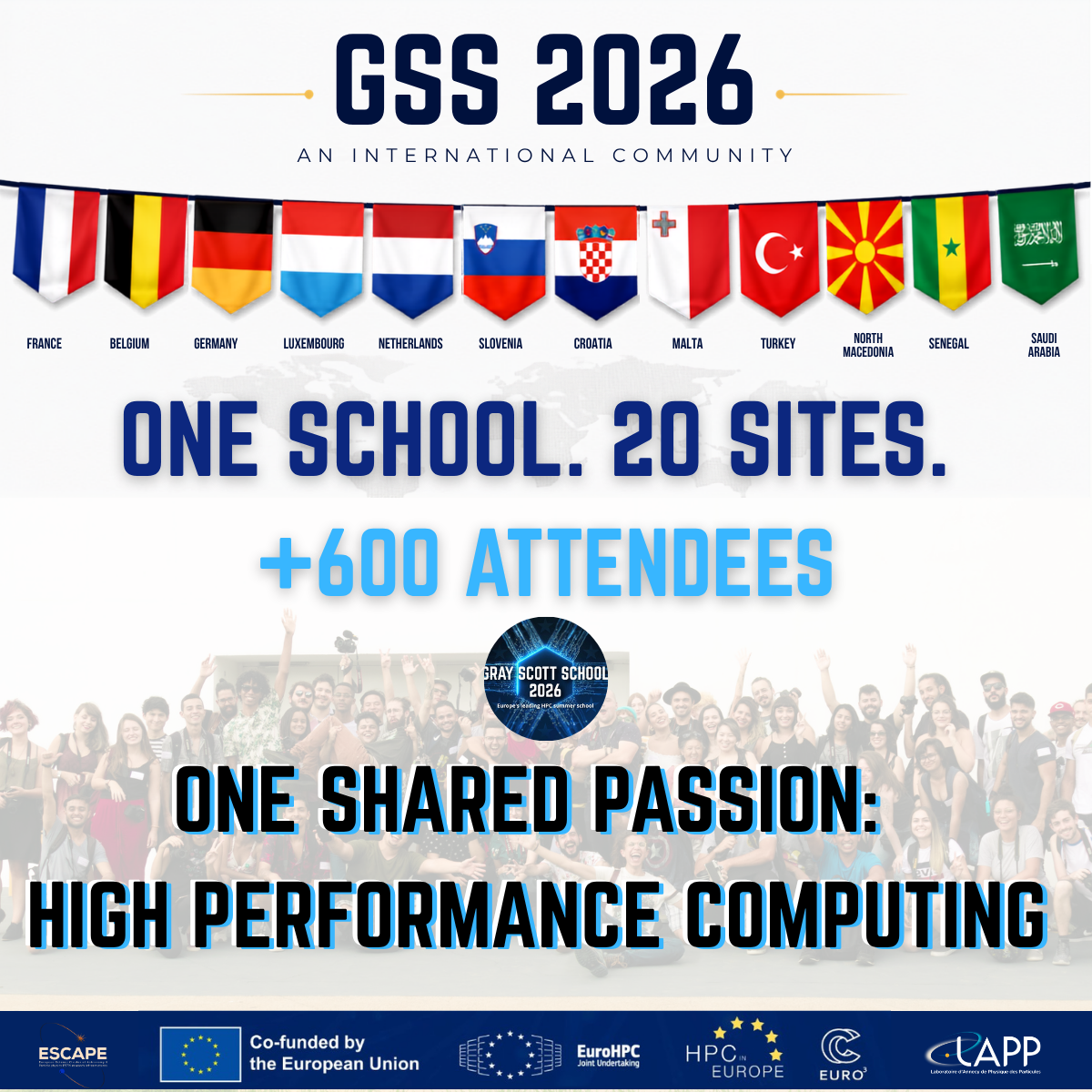
These partners opened their HPC centres to host local participants, making Gray Scott School a truly international event. Their dedication helped strengthen and grow the HPC community across more than 12 countries. A heartfelt thank you to all of them!
Belgium – Leuven (KULeuven, ICTS)
Belgium – Namur (UNamur)
Croatia – Zagreb (NCC Croatia)
France – IDF (Maison de la Simulation)
France – Lyon (INRIA – Campus de La Doua)
France – Nantes (GLICID)
France – Reims (URCA)
France – Rouen (CRIANN)
France – Toulouse (CNES)
France – Toulouse (CERFACS)
Germany – Stuttgart (SIDE – HLRS)
Luxembourg – Luxembourg (University)
Malta – Birkirkara (MDIA)
Netherlands – Amsterdam (NCC Netherlands)
North Macedonia – Skopje (UKIM, FCSE)
Saudi Arabia – King Abdullah University of Science and Technology
Senegal – Dakar (CINERI)
Slovenia – Ljubljana (EuroCC Sling)
Turkey – Mersin (Toros University)
What are Gray Scott Thursdays?
What sets this program apart is its in-depth summer sessions combined with a preparatory series of 18 live webinars, from January to June, known as Gray Scott Thursdays. These webinars, held weekly and presented by the school’s professors, provide an early insight into the key concepts and technologies that will be explored more intensively during the school.
The school focuses on programming and optimization for heterogeneous architectures, with a strong emphasis on understanding hardware behavior and performance bottlenecks. Participants learn how to analyze, optimize, and scale computations on modern computing platforms through practical, hands-on sessions.
Reference Problem – The Gray Scott Reaction
All optimization techniques taught during the school are illustrated using a single reference problem: the simulation of a Gray Scott reaction.
<< Check the 2025 presentation, for more details (Gray Scott Reaction explained @ 3min53s)
This problem is simple enough to be quickly understood, yet complex enough to challenge compilers and reveal performance limitations. Each method is explored through baseline implementations and progressively optimized versions, allowing participants to compare approaches, quantify performance gains, and discuss trade-offs in a concrete and reproducible way.
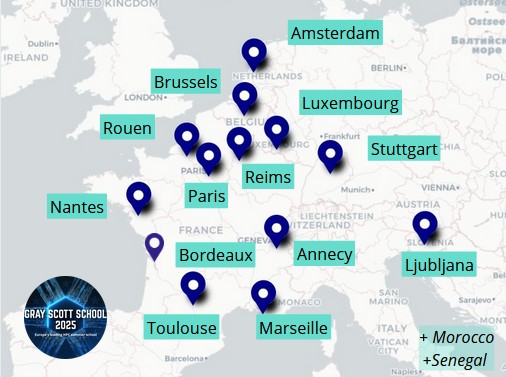
Last year, the Gray Scott School gathered nearly 500 participants across 14 satellite sites in France, Europe, and North Africa. The program offered a unique opportunity to explore high-performance computing, simulation, and modern software techniques with experts in the field.
The LAPP is a joint research unit of CNRS and Université Savoie Mont Blanc, actively involved in experimental and theoretical particle physics, astroparticle physics, and scientific computing. Within international collaborations and European initiatives, the laboratory has developed strong expertise in large-scale computing, performance optimization, and training activities.
The CC-FR Competence Centre provides expertise in high-performance computing, software optimization, and advanced computing technologies. Through its training and support activities, CC-FR, as part of the EuroCC Project, contributes to bridging the gap between modern computing architectures and scientific applications.
Together, LAPP and CC-FR combine scientific excellence, technical expertise, and pedagogical experience to deliver the Gray Scott School as a high-level international training event in high-performance and scientific computing.
The Gray Scott School would not be possible without the invaluable support of our partners and sponsors.
Thanks to their trust and continued enthusiasm, we are able to design, deliver, and widely share high-quality training content, free of charge, with the scientific and academic communities. Their support plays a key role in making the Gray Scott School accessible to a broad and diverse audience, and in fostering the dissemination of knowledge in high-performance computing and scientific software.
We warmly thank all our partners and sponsors for their commitment, their confidence, and their long-term involvement, which make the Gray Scott School possible year after year.