Your HPC Summer School – Programmation and optimization on Heterogeneous Architectures

Presentation
The GRAY SCOTT SCHOOL 2026 is a unique summer school offering an immersive journey into High-Performance Computing, software engineering, and computational optimization.
What sets this program apart is its hands-on, in-depth summer sessions combined with a preparatory series of 17 live webinars, known as Gray Scott Thursdays. These webinars, held weekly and presented by the school’s professors, provide an early insight into the key concepts and technologies that will be explored more intensively during the school.
By combining advanced webinars with intensive on-site training, GSS 2026 equips researchers and students with the skills, methods, and practical experience needed to tackle complex computational challenges and stay at the forefront of scientific computing.
Scientific & Technical Scope
The school focuses on programming and optimization for heterogeneous architectures, with a strong emphasis on understanding hardware behavior and performance bottlenecks.
Participants learn how to analyze, optimize, and scale computations on modern computing platforms through practical, hands-on sessions.
Reference Problem – The Gray Scott Reaction
All optimization techniques taught during the school are illustrated using a single reference problem: the simulation of a Gray Scott reaction.
This problem is simple enough to be quickly understood, yet complex enough to challenge compilers and reveal performance limitations. Each method is explored through baseline implementations and progressively optimized versions, allowing participants to compare approaches, quantify performance gains, and discuss trade-offs in a concrete and reproducible way.
Technologies covered
Programming Languages
C++17 / C++20
CUDA
Fortran
Rust
Python
Julia
Libraries & Frameworks
SYCL
EVE
NumPy / cuNumeric
Thrust
cuPy
PyTorch
JAX
Vulkan
Compilers & Profiling Tools
g++, clang++, nvc++, dpc++
gfortran, nvfortran
Valgrind
MAQAO
Perf
Nsight
Malt
NumaProf
Format
On-site and hybrid
Language
English
Level
Suitable for graduate students, researchers, and professionals with basic HPC knowledge.
Registration
You can register to:
- Gray Scott Thursdays online webinars
- The full GSS 2026 Summer School (on site or remotely)
Gray Scott Thursdays
In the weeks leading up to Gray Scott School 2026, the Gray Scott Thursdays program offers one live webinar every Thursday.
These webinars, presented by the school’s own professors, provide a first glimpse into the topics that will be explored more deeply and intensively during the summer school.
Topics include CPU/GPU architectures, memory allocation, profiling, and testing, using modern programming languages such as C++, Rust, Fortran, and Python, as well as libraries like SYCL, EVE, Vulkan, CUDA, Thrust, and PyTorch.
Participation in the webinars is optional and not required to attend the summer school, but they are a unique opportunity to get a head start and prepare for the intensive on-site experience.
Even attending just the webinars will give participants valuable insights and practical knowledge they can apply immediately.
Technical Program
Explore the full technical program below. This detailed schedule is maintained by the school’s team and reflects the in-depth topics covered during the summer school.
Looking Back at GSS 2025
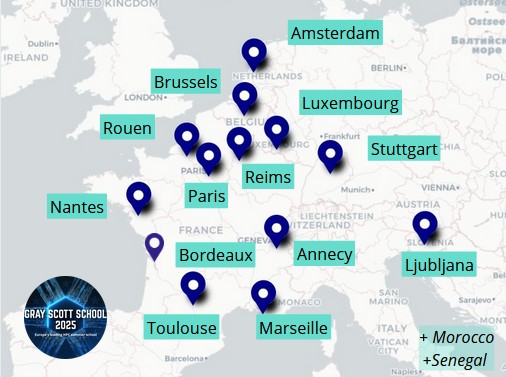
Last year, the Gray Scott School gathered nearly 500 participants across 14 satellite sites in France, Europe, and North Africa.
The program offered a unique opportunity to explore high-performance computing, simulation, and modern software techniques with experts in the field.
Partners & organizers
The Gray Scott School 2026 is organized by the Laboratoire d’Annecy de Physique des Particules (LAPP, CNRS – CNRS Nuclei & Particles), in collaboration with the CC-FR Competence Centre.
The LAPP is a joint research unit of CNRS and Université Savoie Mont Blanc, actively involved in experimental and theoretical particle physics, astroparticle physics, and scientific computing. Within international collaborations and European initiatives, the laboratory has developed strong expertise in large-scale computing, performance optimization, and training activities.
The CC-FR Competence Centre provides expertise in high-performance computing, software optimization, and advanced computing technologies. Through its training and support activities, CC-FR, as part of the EuroCC Project, contributes to bridging the gap between modern computing architectures and scientific applications.
Together, LAPP and CC-FR combine scientific excellence, technical expertise, and pedagogical experience to deliver the Gray Scott School as a high-level international training event in high-performance and scientific computing.
The Gray Scott School would not be possible without the invaluable support of our partners and sponsors.
Thanks to their trust and continued enthusiasm, we are able to design, deliver, and widely share high-quality training content, free of charge, with the scientific and academic communities. Their support plays a key role in making the Gray Scott School accessible to a broad and diverse audience, and in fostering the dissemination of knowledge in high-performance computing and scientific software.
We warmly thank all our partners and sponsors for their commitment, their confidence, and their long-term involvement, which make the Gray Scott School possible year after year.


