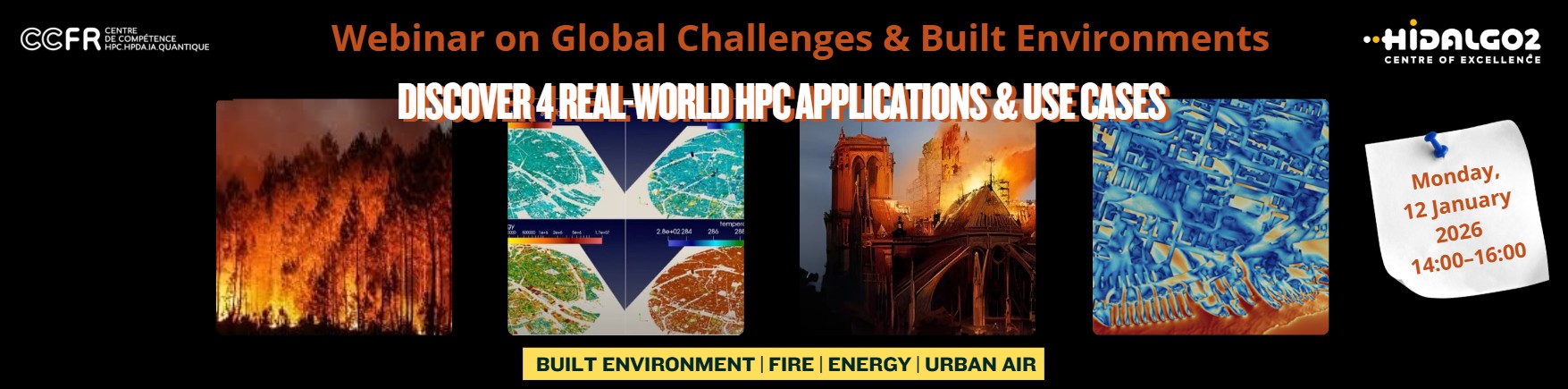
Global Challenges and Built Environments: 4 HPC Applications & Use Cases
Date: 12 January 2026
Time: 14:00–16:00 (Paris time, CET)
Language: English
Format: Online webinar
Organized by: CC-FR (NCC France) & CoE HiDALGO2
About the webinar
High-Performance Computing (HPC) is increasingly at the heart of how we understand, model, and respond to major global challenges affecting our built environments. From wildfires threatening urban areas, to post-fire reconstruction of historical monuments, to urban energy systems and air quality, HPC enables simulations and digital twins at unprecedented scales and levels of detail.
This webinar is fully dedicated to concrete HPC use cases, illustrated with real demonstrations, workflows, and applied examples. It is designed to show how advanced numerical models, large-scale simulations, and digital twins are actually used today to support decision-making, risk assessment, and innovation in the built environment.
Whether you are directly involved in HPC and simulation, working in urban planning or engineering, or simply curious about how cutting-edge computing helps tackle real-world problems, this event will provide practical insights and inspiring applications.
What to expect
- Live demonstrations and end-to-end workflows
- Applications ranging from fire damage and reconstruction to urban energy and air pollution
- Insights from leading experts involved in European research and industrial projects
- Live Q&A sessions with each speaker
4 real-world HPC use cases applied to the built environment:
- Trans-scalar simulation of wildfires and their impact on populated areas using CFD solutions on HPC clusters, presented by David Caballero from MeteoGrid S.L. (Spain)
- City-scale energy simulation for the built environment: from data to HPC simulations and decision support, presented by Christophe Prud’homme from Cemosis – Centre for Modeling & Simulation, University of Strasbourg (France)
- Thermo-mechanical calculation of the masonry during the fire at Notre-Dame Cathedral in Paris, presented by Pierre Morenon from Laboratoire Matériaux et Durabilité des Constructions (LMDC), Toulouse (France)
- High-Resolution, Real-time Digital Twin for the Urban Air with Applications to Wind Comfort and Hazardous Gas Dispersion Modelling at City Scale, presented by Zoltán Horváth from MathSO – Mathematical Simulation and Optimization Research Group, Széchenyi István University (Hungary)
Each speaker will have 20 minutes for their presentation, followed by a dedicated live Q&A to interact directly with the audience.
Who is this event for?
- Researchers
- Industry experts
- SMEs in the technology sector
- Policy makers and public authorities
- Members of the general public interested in HPC, simulation, and technology
Speakers & Presentations
1. Trans-scalar simulation of wildfires and their impact on populated areas using CFD solutions on HPC clusters
About the speaker
David Caballero, from MeteoGrid S.L. (Spain) has specialized in wildfire risk analysis and simulation since 1989 and is a pioneer in Spain in fire behavior modeling and decision-support systems. He has contributed to around twenty European projects on natural hazards and wildfires, coordinated the European wildfire risk observatory for the wildland–urban interface (WUIWATCH), and led several major research initiatives. Currently, he coordinates wildfire activities at MeteoGrid and works on CFD-based fire modeling, digital twins, and virtual reality demonstrators.
About the presentation
Wildfires are complex phenomena involving the interaction between terrain, vegetation, fire, and the atmosphere. Experience shows that it is difficult to rely on a single approach for their simulation, making a trans-scale approach necessary. Wildfires pose a threat to populated areas, both through the direct impact of the flame front and firebrands (flying embers), as well as through smoke emission and dispersion. This presentation introduces techniques, methods, and models for simulating fire spread within the HIDALGO2 project, incorporating fire–atmosphere interactions and smoke dispersion across the landscape, along with detailed simulation of fire and smoke behavior around homes. To achieve this, open-source CFD models at multiple scales have been implemented on HPC clusters. Special attention is given to methods for describing the three-dimensional distribution of biomass and how this information is used in detailed simulations of fire spread in WUI areas and fire behavior around buildings. The strategy for advanced visualization of fire and smoke is also presented, as well as the virtual reality demonstrator.
Software highlighted
WRF-SFIRE, OpenFOAM / fireFoam (open source)
Watch his Youtube channel: https://www.youtube.com/@davidcaballero8258
2. City-scale energy simulation for the built environment: from data to HPC simulations and decision support
About the speaker
Christophe Prud’homme is Professor of Applied Mathematics at the University of Strasbourg and Director of Cemosis. His work focuses on high-performance scientific computing, model reduction, and open-source software, notably the Feel++ framework.
He is actively involved in national and European initiatives on exascale computing and digital twins for cities and energy systems.

About the presentation
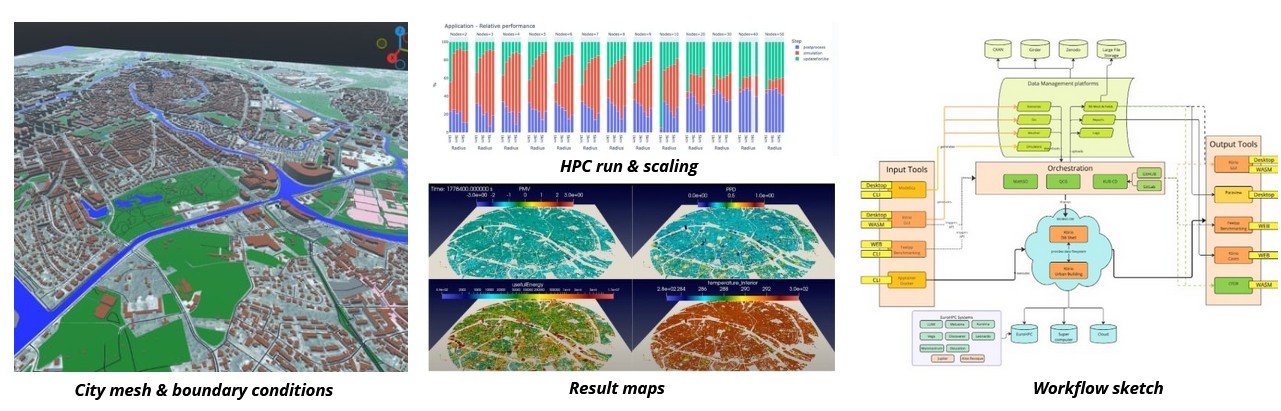
Urban planners and utilities are increasingly relying on digital twins to quantify energy use, microclimate, and resilience. I’ll present our end-to-end pipeline, which includes data ingestion (GIS), meshing and model setup, large-scale energy simulation on HPC, and automated reporting, for district-to-metro scale scenarios. We’ll share use cases from the HiDALGO2 CoE (addressing global challenges) and the Exa-MA/NumPEx program (developing methods & algorithms for exascale), demonstrating how open tools and reproducible CI/CD enable the transformation of complex numerics into actionable insights for the built environment.
Software highlighted
Feel++, Ktirio, Gmsh, ParaView, Docker, GitHub Actions
Thermo-mechanical calculation of the masonry during the fire at Notre-Dame Cathedral in Paris
About the speaker
Pierre Morenon is a research engineer (PhD) at LMDC in Toulouse, France, specializing in non-linear numerical modeling of masonry and reinforced concrete structures.
His work focuses on the behavior of structures under service and extreme loads, including fire, with applications to bridges, tunnels, dams, nuclear facilities, and historical monuments.
About the presentation
Following the 2019 fire at Notre-Dame Cathedral, assessing structural damage and guiding reconstruction became a critical challenge. This talk presents a 3D thermo-mechanical finite element methodology to diagnose masonry affected by fire. The nonlinear model accounts for thermal expansion, material degradation, and cracking phenomena, and is calibrated using on-site measurements and experimental data. Once validated, the model supports post-fire stability assessment and evaluation of strengthening strategies.
Software highlighted
Code_Aster, Cast3M (free and open source for academic use)
High-Resolution, Real-time Digital Twin for the Urban Air with Applications to Wind Comfort and Hazardous Gas Dispersion Modelling at City Scale
About the speaker
Zoltán Horváth is Professor of Mathematics and Computer Science at Széchenyi István University and founder of the MathSO research group.
His work focuses on industrial and applied mathematics, large-scale simulations, and digital twins. He has led numerous European research and innovation collaborations and is currently head of the Space Technology and Space Law Research Center.
About the presentation
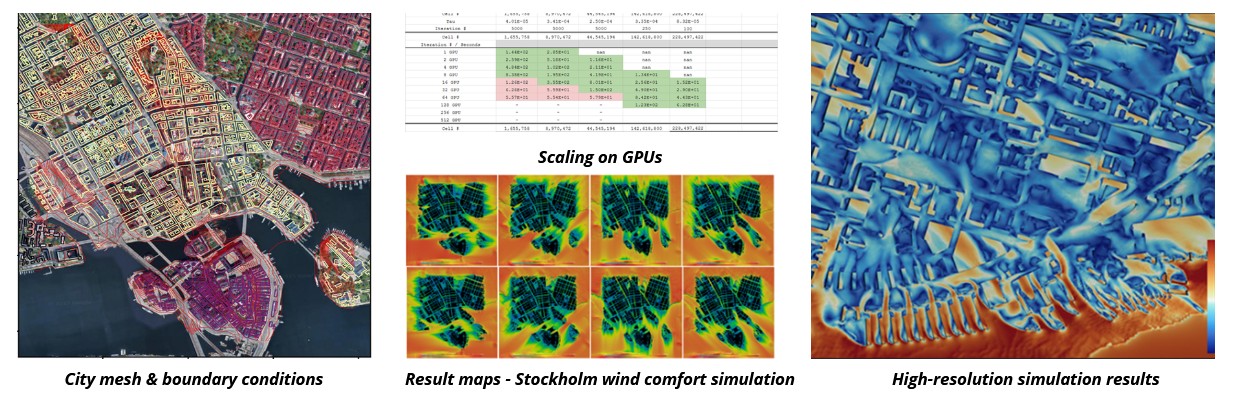
This presentation introduces the Urban Air Project (UAP), a real-time, high-resolution digital twin for city-scale wind comfort and hazardous gas dispersion modeling. The application runs on both EuroHPC systems and local desktops through a user-friendly GUI, with real-time web visualization. A detailed Stockholm City use case, developed with ENCCS and SLB Analys and featured as a EuroCC success story, will be presented.
Software highlighted
RedSim – open-source, GPU-native CFD framework for urban-scale simulations & Automated Tool For Urban Wind Comfort Computations
Join us!
This webinar is a key HPC event for anyone interested in applied simulations, digital twins, and real-world HPC deployments for the built environment. Expect concrete examples, live demonstrations, and direct exchanges with experts shaping the future of HPC-driven decision support.
Organizers
This webinar is organized by NCC France (CC-FR) and the HiDALGO2 Centre of Excellence (CoE Hidalgo), both key contributors to the EUROCC project, the European network of National Competence Centres for High-Performance Computing. NCC France (https://www.ncc-france.fr) supports HPC adoption across French research, industry, and SMEs, providing expertise, training, and access to national and European HPC resources. The HiDALGO2 CoE (https://www.hidalgo2.eu) promotes HPC applications for global societal challenges, enabling research, knowledge transfer, and industrial collaboration in fields such as energy, environment, and built environments.
We also warmly thank the host organizations of our speakers for their support: MeteoGrid S.L. (https://www.meteogrid.com), specialized in weather forecasting and wildfire risk management; Cemosis – Centre for Modeling & Simulation, University of Strasbourg (https://www.cemosis.fr), a hub for HPC, modeling, and data-driven solutions; Laboratoire Matériaux et Durabilité des Constructions (LMDC), Toulouse (https://www.lab-lmdc.fr), focusing on sustainable civil engineering and structural durability; and MathSO – Mathematical Simulation and Optimization Research Group, Széchenyi István University (https://uni.sze.hu/), experts in industrial and urban-scale mathematical modeling.